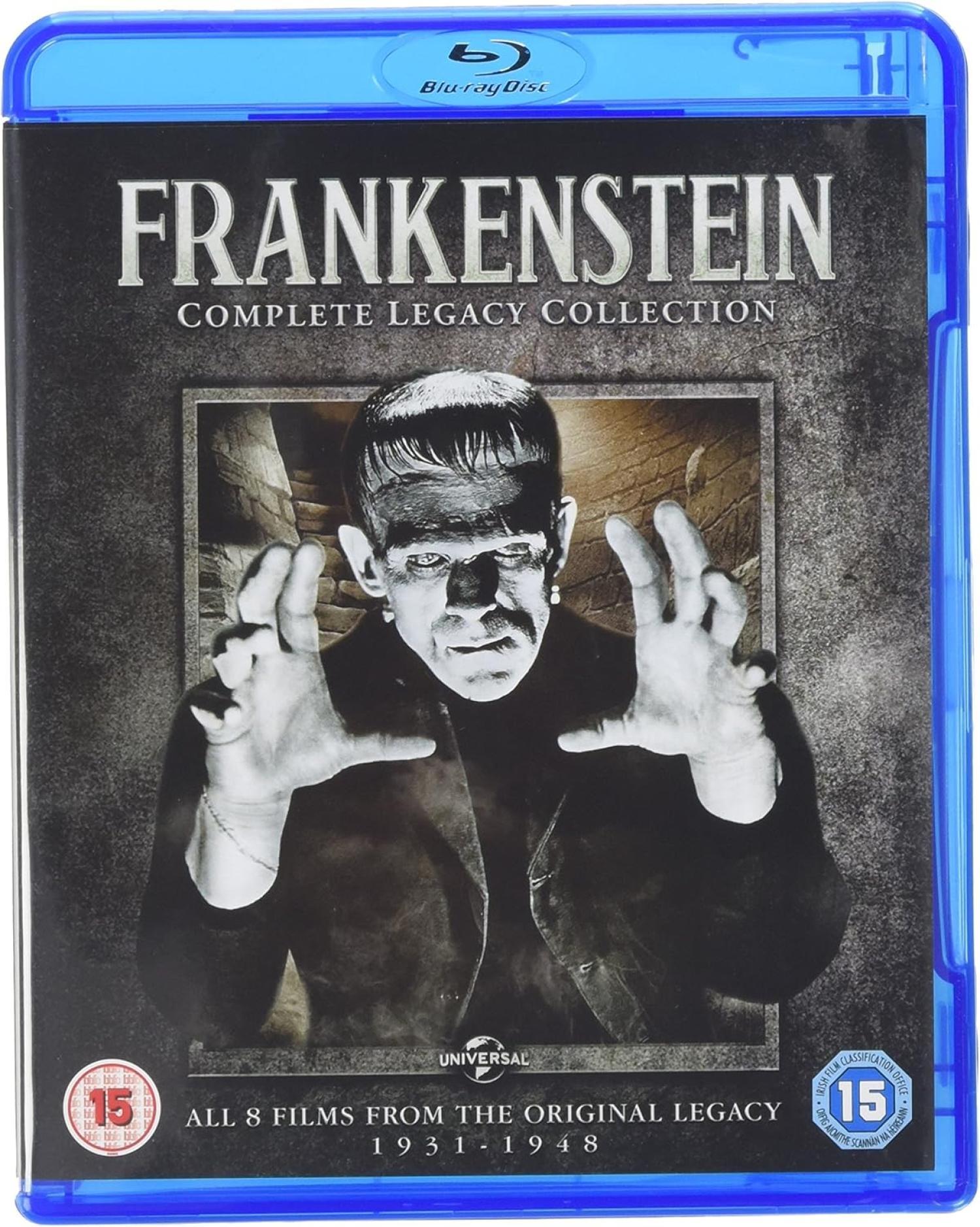
Frankenstein - Legacy Collection
Frankenstein (1931) | The Bride of Frankenstein (1935) | Son of Frankenstein (1939) | The Ghost of Frankenstein (1942) | Frankenstein Meets the Wolf Man (1943) | House of Frankenstein (1944) | House of Dracula (1945) | Abbott and Costello Meet Frankenstein (1948)
(Inspired by Frankenstein; or, The Modern Prometheus (1818) by Mary Shelley.) | Complete Legacy Collection (1931-1945)
8 Movie Collection (1931-1948)
| Genres: | |
| Subgenres: | |
| Themes: | |
| Persons: | |
| Labels: |
Frankenstein (1931)
Directed by James Whale, Frankenstein adapts Mary Shelley’s novel into a stark, expressionist tale of scientific ambition and unintended consequence. Boris Karloff’s performance as the Monster brings vulnerability and physicality to one of cinema’s most enduring figures. Its laboratory imagery, moral tension, and stylized atmosphere helped define the Universal horror cycle and early sound-era genre filmmaking.
The Bride of Frankenstein (1935)
The Bride of Frankenstein, also directed by James Whale, deepens the original film’s themes as the Monster seeks companionship while a renewed experiment brings forth a second creation. The film blends gothic horror with dark humor, religious symbolism, and heightened visual design. Often regarded as one of the greatest horror sequels, it expands the emotional and stylistic range of the Frankenstein myth.
Son of Frankenstein (1939)
Directed by Rowland V. Lee, Son of Frankenstein follows the scientist’s son as he returns to his ancestral estate and becomes entangled in local resentment and the Monster’s lingering presence. The film features angular sets and shadow-heavy composition that echo German Expressionism. Its revived focus on legacy, guilt, and manipulation helped renew interest in Universal’s horror franchise.
The Ghost of Frankenstein (1942)
The Ghost of Frankenstein, directed by Erle C. Kenton, centers on a new generation of scientists whose attempts to help the Monster lead to renewed experimentation and deception. The film mixes courtroom melodrama, medical speculation, and familiar monster motifs. Its narrative shifts toward science fiction mark the franchise’s wartime evolution.
Frankenstein Meets the Wolf Man (1943)
Directed by Roy William Neill, Frankenstein Meets the Wolf Man unites two of Universal’s most iconic characters as Larry Talbot seeks an end to his curse and encounters the Monster during his search for Dr. Frankenstein’s secrets. The film blends gothic drama with crossover spectacle, establishing the template for Universal’s multi-monster continuity. Its themes of fatalism and unintended consequence tie the separate mythologies together.
House of Frankenstein (1944)
In House of Frankenstein, directed by Erle C. Kenton, a deranged scientist encounters Dracula, the Wolf Man, and the Monster while pursuing forbidden experiments. The film adopts an ensemble-horror structure, giving each creature a distinct narrative thread. Its mix of science fiction, supernatural motifs, and carnival atmosphere expands the studio’s shared-monster universe.
House of Dracula (1945)
House of Dracula, also directed by Erle C. Kenton, returns Dracula, the Wolf Man, and the Monster to a single storyline centered on a doctor seeking scientific cures for their afflictions. The film blends medical experimentation with gothic elements, emphasizing transformation, desperation, and the fragile boundary between science and horror. It serves as a later-stage entry in Universal’s crossover cycle.
Abbott and Costello Meet Frankenstein (1948)
Directed by Charles Barton, Abbott and Costello Meet Frankenstein pairs the comedy duo with Dracula, the Wolf Man, and the Monster in a blend of slapstick and genuine horror atmosphere. The monsters are played straight, allowing comedy and classic horror to coexist within a single narrative. The film revitalized Universal’s creature lineup and became one of the most influential horror-comedies ever made.
| Label | Universal Classic Monsters |
| Distributor | Universal Pictures |
| Inspelningsår | 1931 |