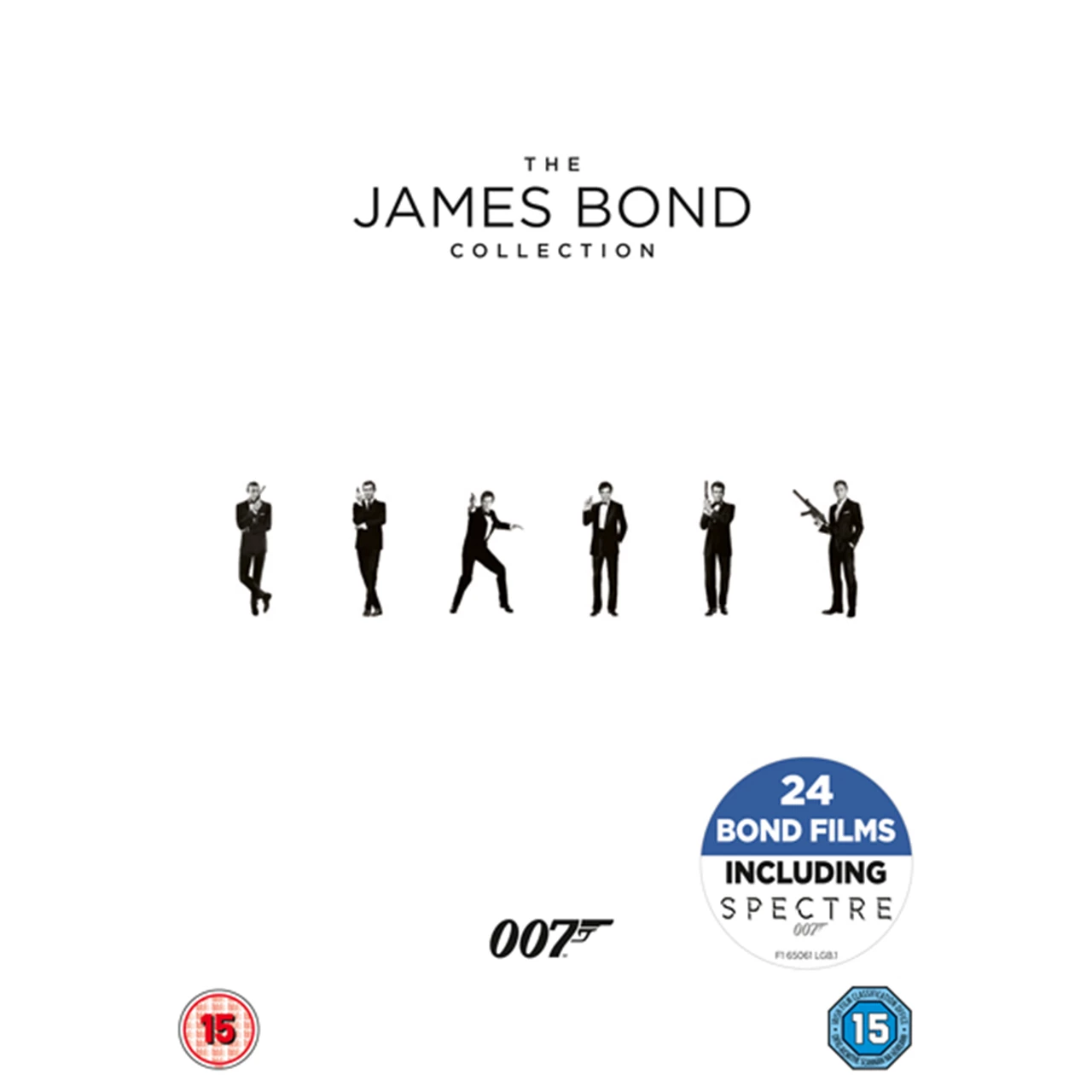
James Bond (1962-2015)
Dr. No (1962) | From Russia with Love (1963) | Goldfinger (1964) | Thunderball (1965) | You Only Live Twice (1967) | Diamonds Are Forever (1971) | Live and Let Die (1973) | The Man with the Golden Gun (1974) | The Spy Who Loved Me (1977) | Moonraker (1979) | For Your Eyes Only (1981) | Octopussy (1983) | A View to a Kill (1985) | The Living Daylights (1987) | Licence to Kill (1989) | GoldenEye (1995) | Tomorrow Never Dies (1997) | The World Is Not Enough (1999) | Die Another Day (2002) | Casino Royale (2006) | Quantum of Solace (2008) | Skyfall (2012) | Spectre (2015)
24 Movie Collection (1962-2015)
| Genres: | |
| Subgenres: | |
| Themes: |
Dr. No (1962)
Directed by Terence Young, Dr. No introduces James Bond as he investigates the disappearance of a British agent in Jamaica, uncovering a plot led by the enigmatic Dr. No. The film blends Cold War intrigue with exotic-locale espionage, defining many stylistic elements that would shape the Bond formula. Its measured tension, minimalist gadgetry, and iconic production design established the foundation of the 007 franchise.
From Russia with Love (1963)
From Russia with Love, directed by Terence Young, follows Bond as he becomes entangled in a SPECTRE scheme involving a decoding device and a complex web of double agents. Blending spycraft, romance, and escalating political tension, the film expands the scale and sophistication of the series. Its train-bound climax and shadowy conspiracies highlight Bond’s transition into more intricate geopolitical storytelling.
Goldfinger (1964)
Directed by Guy Hamilton, Goldfinger features Bond confronting a gold-obsessed industrialist whose plan threatens global economic stability. The film blends espionage with memorable set pieces, refined gadgetry, and heightened villain characterization. Its polished pacing and iconic imagery—including the Aston Martin DB5—cemented the template for the classic Bond style.
Thunderball (1965)
Thunderball, directed by Terence Young, centers on a SPECTRE plot involving stolen nuclear warheads hidden beneath the ocean. The film blends large-scale underwater action with international intrigue, emphasizing elaborate stunt work and Cold War anxiety. Its expansive scope and technical ambition marked it as one of the franchise’s major early spectacles.
You Only Live Twice (1967)
Directed by Lewis Gilbert, You Only Live Twice sends Bond to Japan to investigate mysterious spacecraft disappearances tied to a concealed SPECTRE base. The film blends espionage with space-race tensions, elaborate set construction, and a broadened global threat. Its volcanic lair, cultural immersion, and heightened adventure tone helped define the more operatic direction of late-1960s Bond films.
Diamonds Are Forever (1971)
Directed by Guy Hamilton, Diamonds Are Forever follows Bond as he infiltrates a diamond smuggling ring that leads to a larger plot involving satellite warfare. The film blends Las Vegas extravagance with espionage, camp-inflected humor, and returning franchise villains. Its tonal shift toward stylized spectacle reflects the transitional era of early-1970s Bond.
Live and Let Die (1973)
Live and Let Die, directed by Guy Hamilton, introduces Roger Moore as Bond in a mission involving a Caribbean dictator, drug trafficking, and a conspiracy tied to voodoo-infused folklore. The film blends espionage with blaxploitation influences, boat-chase stunt work, and a broader cultural palette. Its tonal lightness and adventurous energy set Moore’s era apart from the preceding films.
The Man with the Golden Gun (1974)
Directed by Guy Hamilton, The Man with the Golden Gun pits Bond against assassin Francisco Scaramanga in a duel that intertwines personal rivalry with a plot involving solar energy technology. The film blends exotic locales, martial-arts influences, and a more intimate cat-and-mouse structure. Its villain-centric focus and island-lair aesthetics highlight mid-1970s Bond style.
The Spy Who Loved Me (1977)
The Spy Who Loved Me, directed by Lewis Gilbert, follows Bond as he partners with Soviet agent Anya Amasova to stop a megalomaniac seeking to create an underwater civilization. The film blends large-scale action with Cold War cooperation, featuring iconic sequences such as the Lotus Esprit submarine car. Its balance of spectacle and character chemistry makes it one of the most celebrated entries of the franchise.
Moonraker (1979)
Directed by Lewis Gilbert, Moonraker expands Bond’s scope into near-future science fiction as he investigates a shuttle manufacturer plotting to repopulate Earth with a genetically curated society. The film blends spy adventure with space-race spectacle, incorporating elaborate sets, aerial stunts, and the return of recurring villain Jaws. Its heightened ambition epitomizes the franchise’s late-1970s blockbuster phase.
For Your Eyes Only (1981)
Directed by John Glen, For Your Eyes Only returns Bond to a more grounded espionage narrative as he investigates the sinking of a British reconnaissance device and the race to recover it. The film blends Cold War intrigue with alpine action, emphasizing realism, tactical tension, and personal stakes. Its stripped-back approach reorients the franchise after the heightened spectacle of the late 1970s.
Octopussy (1983)
Octopussy, directed by John Glen, blends a smuggling operation with a nuclear plot involving rogue Soviet elements as Bond infiltrates a circus-based criminal network. The film combines exotic locales, espionage, and stylized action with lighter comedic touches characteristic of the Moore era. Its mixture of Cold War tension and pulp adventure reflects the franchise’s early-1980s tone.
A View to a Kill (1985)
Directed by John Glen, A View to a Kill follows Bond as he confronts an industrialist plotting to monopolize the global microchip market through a catastrophic plan targeting Silicon Valley. The film blends corporate espionage, high-altitude stunts, and urban set pieces. Its stylish villain dynamics and blend of modern industry with classic Bond spectacle close out the Roger Moore era.
The Living Daylights (1987)
The Living Daylights, directed by John Glen, introduces Timothy Dalton with a more serious, literary-inspired portrayal as Bond becomes involved in a defection scheme masking a global arms conspiracy. The film blends Cold War politics with grounded action, focusing on tactical realism and character-driven conflict. Its tone marks a shift toward a more intense interpretation of the character.
Licence to Kill (1989)
Directed by John Glen, Licence to Kill follows Bond on an unsanctioned revenge mission against a powerful drug lord who attacked a close friend. The film blends action-thriller structure with darker emotional motives, emphasizing moral ambiguity and personal loyalty. Its more violent, contemporary tone stands as the boldest stylistic departure of the pre-1990s Bond era.
GoldenEye (1995)
Directed by Martin Campbell, GoldenEye reintroduces Bond for the post–Cold War era as he faces a rogue MI6 agent who wields a devastating satellite weapon. The film blends geopolitical transition with updated action choreography, emphasizing shifting alliances and modernized espionage. Its revitalized tone, strong character dynamics, and breakout use of contemporary technology helped relaunch the franchise for a new generation.
Tomorrow Never Dies (1997)
Tomorrow Never Dies, directed by Roger Spottiswoode, pits Bond against a media mogul manipulating global conflict to expand his empire’s influence. The film blends high-tech espionage with large-scale action, highlighting themes of information warfare and corporate manipulation. Its sleek pacing and international settings reflect the late-1990s evolution of the Bond formula.
The World Is Not Enough (1999)
Directed by Michael Apted, The World Is Not Enough explores a complex relationship between Bond and an oil heiress whose family legacy ties into a broader terrorist plot. The film blends emotional intrigue with nuclear stakes, emphasizing character-driven tension and shifting loyalties. Its mix of espionage spectacle and psychological manipulation offers one of the franchise’s more layered narratives.
Die Another Day (2002)
Die Another Day, directed by Lee Tamahori, follows Bond as he uncovers a gene-therapy conspiracy connected to a high-tech weapons platform. The film blends traditional espionage with early-2000s sci-fi influences, featuring global chases, experimental technology, and heightened visual style. Serving as the final Pierce Brosnan entry, it represents the apex of the era’s larger-than-life Bond design.
Casino Royale (2006)
Directed by Martin Campbell, Casino Royale reboots the franchise with Daniel Craig as a newly promoted 00-agent on his first major mission, targeting a financier of global terrorism through a high-stakes poker game. The film blends grounded espionage with character-driven intensity, exploring Bond’s vulnerabilities, emotional attachments, and the formative events that shape his identity. Its stripped-back realism and dramatic weight redefined the series for the modern era.
Quantum of Solace (2008)
Quantum of Solace, directed by Marc Forster, follows Bond in the direct aftermath of Casino Royale as he uncovers a shadow organization manipulating geopolitical resources. The film blends rapid-fire action with themes of grief, betrayal, and institutional opacity. Its narrative focus on emotional fallout and covert power structures continues the character arc established in the reboot.
Skyfall (2012)
Directed by Sam Mendes, Skyfall examines Bond’s loyalty to MI6 as the agency becomes the target of a cyberterrorist with personal ties to M. The film blends psychological drama with global espionage, emphasizing legacy, mortality, and the shifting nature of intelligence work. Its visual ambition, character depth, and thematic resonance made it one of the most critically acclaimed entries in the franchise.
Spectre (2015)
Spectre, directed by Sam Mendes, connects Bond’s previous missions to a single organization led by a figure from his past, intertwining personal history with global surveillance threats. The film blends classic Bond iconography with modern geopolitics, exploring control, memory, and institutional secrecy. Its expansive scope and myth-building elements tie together the Craig-era narrative threads.
| Distributor | MGM |
| Inspelningsår | 1962 |